<!DOCTYPE html>
Common Symptoms of Failing Cast Iron Drain Pipes in Boerne
Common Symptoms of Failing Cast Iron Drain Pipes in Boerne
Across Boerne and greater Kendall County, aging cast iron sewer lines are reaching end-of-life. Many homes near the Hill Country Mile, Northside, and the Historic District still rely on original bell-and-spigot cast iron that went in between the 1950s and the late 1970s. The pipe walls have thinned from corrosion. The interiors have built up thick iron scale. Local geology adds stress. Limestone shelves and pockets of Texas Blackland clay expand and contract. This movement loads horizontal runs and joints until they crack, belly, or separate. The result is slow drains, sewer gas odor, and recurring blockages that no longer respond to simple snaking.
Residents search for cast iron drain pipe repair Boerne because the symptoms keep coming back. A one-time clog is normal. Recurrent clogs, foul smells, or damp soil near the slab are not. Those are structural signals. The fix starts with a precise diagnosis and ends with a repair that can stand up to shifting soil and active households. Gottfried Plumbing llc focuses on trenchless solutions that protect flooring, landscaping, and driveways while restoring the sanitary sewer to reliable, code-compliant service.
Executive Entity Report: What Fails, Why It Fails, and How It Gets Fixed in Boerne
In cast iron systems, the most common failure modes in Boerne are corrosion, tuberculation, and channeling. Corrosion thins the pipe wall and weakens joints. Tuberculation is heavy rust scaling that narrows the internal diameter, snags wipes, and feeds sludge buildup. Channeling is the trench worn into the pipe floor where wastewater travels for decades. Once channeling exposes raw metal, flow undercuts the bottom until the line starts to hold water. That belly then traps solids and creates blockages downstream of each fixture group.
Hydrogen sulfide gas forms when waste stagnates in those bellies. It converts to sulfuric acid on damp iron surfaces, which accelerates corrosion. Homeowners often first notice a rotten egg smell near the laundry standpipe, a bathroom floor drain, or the cleanout. That odor may also leak from hairline cracks in the vent stack or main drain line. Tree root intrusion is frequent in yards with mature live oaks and cedar elms. Roots seek moisture at joints and at breaks, invade the sewer lateral, and worsen the blockage cycle. Over time, hydrostatic pressure under the slab can force wastewater along the path of least resistance, which leads to slab leaks, soil washout, and foundation distress.
The parts most often involved include the main drain line under the slab, the sewer lateral to the city tap, cleanout risers, and the old bell-and-spigot joints that allow a tiny wiggle under soil movement and then gape. During repair, modern components replace or reinforce those segments. Examples include epoxy liner sleeves that create a continuous inner pipe, PVC Schedule 40 for under-slab rebuilds where excavation is feasible, and SDR-35 for yard laterals. Fernco couplings provide secure transitions between dissimilar materials and help isolate vibration while preserving alignment.
Boerne repairs today favor trenchless methods. Trenchless pipe lining, also called CIPP or cured-in-place pipe, allows the team to rehabilitate the interior of the sewer lateral and many under-slab sections from existing access points. The crew cleans and descales the interior using high-speed milling tools, then inverts an epoxy-saturated felt liner through the prepared pipe, often with an inversion drum. A calibration tube sets the right thickness and fit. After curing, an epoxy liner forms a new, jointless inner pipe that resists chemicals and blocks future root intrusion. Pipe bursting is another trenchless option for certain yard laterals. It pulls a new line through the alignment while fracturing the old cast iron into the surrounding soil.
Diagnostics rely on specialized equipment. A self-leveling sewer camera, often from Ridgid, documents interior condition from cleanout to city tap. The video shows tuberculation, channeling, cracks, offsets, and bellies. A hydro-jetter clears heavy buildup and roots when needed, and a Picote high-speed descaling machine smooths the iron wall to accept epoxy. Pneumatic cutting tools remove intruding tap saddles or protruding screws. During lining, an inversion drum and calibration tube guide and shape the CIPP. After cure, the crew reinstates branch connections using a robotic cutter. For Boerne property owners, the final video report provides clear proof of the before and after condition, which anchors warranty claims and insurance documentation.
Why Boerne Homes See These Symptoms
Boerne’s building stock and soil profile explain most failures. Many homes near Cibolo Creek, Main Plaza, and the Kendall County Courthouse sit on soils that cycle between wet and dry across seasons. Clay zones swell after heavy rains and shrink in drought. The slab moves. Old bell-and-spigot joints tolerate a few millimeters of motion until the spigot cuts into the bell. Over years, that movement becomes a circumferential crack that passes gas and later leaks liquid. In Northside and the Woods of Boerne, mid-century developments used cast iron for both under-slab and yard laterals. Those lines are now beyond their original life expectancy, which was about 50 years under ideal conditions. Few lines in Kendall County enjoyed ideal conditions.
Tree proximity is another factor. In Cordillera Ranch, Fair Oaks, and along the Hill Country Mile, mature root systems stretch across utility easements. A single hair root finds the joint, grows into the lumen, and thickens. Roots catch paper and solids. The obstruction slows flow. The resulting surcharge sends wastewater back into lower fixtures like showers and tubs. That backflow lays down grease rings on the wall. The rings remain even after the flood recedes, which is a telltale sign on camera.
Limestone ledges can also bow unsupported sections. A pipe run that crosses a small void in fractured rock will slump over time. That creates a belly. The camera will show standing water that persists after upstream flow stops. In older houses near the Historic District, remodels cut through or re-routed vent stacks. Those changes often used slip couplings that were not shielded. Unshielded couplings allow shear movement under load. The joint ovals out under backfill or slab bearing and starts to seep. All of these local factors compound the classic cast iron decay profile.
The First Signs that Mean Trouble
Homeowners usually notice three patterns before the system fails outright. The first is recurring slow drains that return even after snaking. Snakes open a hole through soft obstructions but leave tuberculation intact. Iron scale continues to grab wipes and hair. The second is a faint rotten egg smell on hot, humid days. Hydrogen sulfide rises through dry traps and hairline cracks, especially where the vent stack passes through a warm attic and then through a cool roof deck. The third is patchy green grass or a wet spot above the lateral after a dry week. That moisture often marks a fractured section under the yard. Some owners also see a small roach migration near floor drains. That points to air movement from the sanitary line into the living space.
If a toilet gurgles when a tub drains, that cross talk means the main drain line is restricted. Air cannot vent through the typical path, so it triggers a pressure change at nearby fixtures. If a washing machine discharge flood comes up through a nearby shower, that overflow marks the lowest branch in the chain. The problem is almost never that trap. The restriction sits farther down in the main toward the cleanout or beyond it in the sewer lateral. These small signals, taken together, build a reliable picture even before the camera arrives.
How Pros Diagnose Cast Iron Failure in Boerne Homes
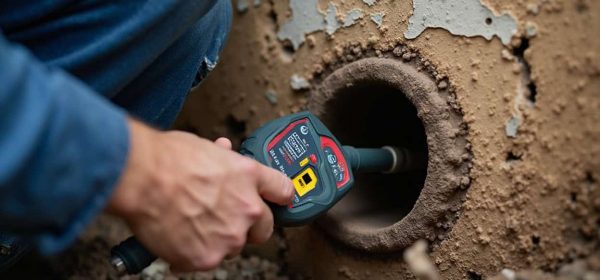
Diagnosis starts at the cleanout. If the property lacks an exterior cleanout, the crew will pull a toilet under plastic protection and use that closet flange. The camera head drops into the main drain line first. A self-leveling Ridgid sewer camera helps everybody understand the picture quickly. Water lines at the three and nine o’clock positions show how deep the belly is. Orange growths or jagged flares on camera indicate tuberculation. Smooth half-moon recesses along the floor mark channeling. Cracks appear as linear dark gaps that widen under push. If the lens fogs when crossing a joint, gas is escaping at that seam. That often pairs with small mineral splatter at the same clock position.
Hydro-jetting may be required before a clear read. Boerne iron often carries decades of scale, and many household lines have a sand-like layer settled in longer bellies. The hydro-jetter scours soft buildup. For hard scale, Picote descaling cutters sand the wall under camera guidance. The cutting is controlled, with short passes to protect remaining iron thickness. Once clean, the crew reinspects. If offsets exceed a practical tolerance for lining, pipe bursting or spot excavation may be smarter. If the camera finds a yard tap that protrudes into the lateral, a pneumatic cutting tool trims it flush before any liner insertion.
Verification tests add confidence. A static pressure test isolates the sanitary system from the vent through test balls and confirms leaks by water level loss. In suspected under-slab slab leaks, a smoke test helps locate cracks that do not pass water in the dry season. Video and test data roll into a final report that guides the repair decision and serves insurance or real estate needs.
Boerne-Specific Repair Paths and Why They Work
For under-slab mains with general corrosion and moderate channeling, trenchless CIPP is the top option. The team installs an epoxy-saturated felt liner through an inversion drum and monitors alignment with the calibration tube. Cure times vary by epoxy chemistry and temperature. After cure, the new epoxy liner is jointless from entry to exit. It resists hydrogen sulfide, blocks live oak roots, and restores round flow, which eliminates the snag points that caused chronic clogs. Where branch lines feed in, robotic cutters reinstate holes at the exact locations shown on the pre-lining map.
If sections have collapsed or offsets are too severe, targeted excavation may be best. Crews shore and open a short trench to remove a broken segment, then rebuild with PVC Schedule 40 for under-slab work. In yards, SDR-35 provides a strong, smooth-walled option that handles soil movement when installed with a proper bedding layer. Shielded Fernco couplings connect PVC to remaining cast iron and maintain alignment under load. Pipe bursting works well on straight laterals with many fractures. The bursting head splits the old iron while pulling in new pipe along the same route, often from two or three small pits that avoid hardscape.
Some Boerne homes benefit from a hybrid approach. Descaling and spot lining stabilize the under-slab, while pipe bursting renews the yard lateral to the city main near Cibolo Creek. In older houses by the Hill Country Mile, teams often re-vent at the roof and update flashing to eliminate attic odor vectors. Work near historic finishes stays trenchless as much as possible to protect plaster, masonry, and landscaping.
Where the Problems Show Up Around Boerne
Calls cluster in the 78006 and 78015 zip codes. In Fair Oaks Ranch and Bergheim, slab-on-grade homes often show bellies near kitchen branches and laundry runs. In the Historic District, where lines are older and trees are established, root intrusion is common at every bell-and-spigot joint. Properties near Boerne City Lake and along Cibolo Creek deal with mixed soils that shift after wet spells. Northside streets built during growth spurts in the late 1960s have laterals that now hold water in multiple low spots. Cordillera Ranch brings long yard runs to the city tap, which adds more room for movement and more joints to fail. Across Kendall County, the same pattern repeats with small differences based on soil and build year.
Nearby support towns feed into the same service map. Comfort, Leon Springs, and Pipe Creek call with similar symptoms, with added rock shelf challenges to the northwest. San Antonio’s north side shares the aging cast iron profile without as much limestone exposure but with larger tree canopies along older streets.
What Homeowners Notice First: A Short Checklist
This quick read helps decide whether to call for a camera inspection now or watch and wait for a week. If two or more of the items occur in the same month, schedule the diagnostic.
- Rotten egg sewer gas odor near a floor drain, tub, or laundry standpipe
- Recurring slow drains that return days after snaking
- A toilet gurgles when another fixture drains
- Wet soil or greener grass bands over the yard lateral
- Backups during laundry discharge that surface in a lower shower
Tools and Brands That Matter for Reliable Results
High-definition Ridgid cameras provide stable, self-leveling video that clients and adjusters can trust. Picote descaling machines remove tuberculation and leave a liner-ready surface. Perma-Liner supplies inversion systems and epoxy chemistries that match pipe diameters and service conditions common in Boerne. NuFlow systems appear in certain branch line scenarios where access is tight. Spartan Tool cable machines still play a role, especially for initial opening of soft blockages. For lining and bursting, brands like HammerHead Trenchless and Miller high-speed cleaners round out the kit. Each brand brings a specific strength. The point is not the sticker on the case. The point is the right tool sequence and a technician who recognizes the signals on camera and adapts the approach to the condition on site.
Gottfried Plumbing llc documents each job with video proof of repair. That includes the pre-cleaning, post-descaling, and post-lining runs. The video shows the reinstated branches and the uniform epoxy liner surface. If the solution involved PVC Schedule 40 or SDR-35 replacement, photos show trench depth, bedding, couplings, and final grade. These visuals back up written warranties and simplify any future service calls by setting a baseline for comparison.
What a Thorough Boerne Diagnostic Looks Like
The visit begins with a short interview to pinpoint symptoms and fixture behavior. A licensed Master Plumber or Master Sewer Technician checks for a working cleanout, inspects roof vents, and notes yard trees and hardscape that affect routing. The crew shields floors and sets up containment before pulling any fixture. Water levels and trap seals are checked. The camera run starts from the lowest point that still drains. The tech maps footage distances to known reference points like the exterior cleanout, foundation edge, or city tap location near the street. If the line is packed with scale, the team may run a small-diameter cutter first, followed by hydro-jetting on a controlled pass.
After a clear view, the tech captures high-value frames that show channeling, cracks, or bellies. These images anchor the repair plan. The report lists options. If the findings show moderate corrosion but stable alignment, trenchless CIPP will likely be the recommendation. If feeder branches enter at multiple elevations, the plan will include reinstatement steps. If the yard lateral is fractured in many places or has a major offset at a utility crossing, pipe bursting or open-trench replacement with SDR-35 might make more sense. A static pressure test may be offered to confirm slab leaks before opening finished floors.
Clear estimates follow. They define access points, lengths, diameters, resin types, cure times, couplings, code inspection steps with the City of Boerne, and surface restoration. Clients see the path from symptom to solution, not a guess and not a general promise. That clarity reduces surprises and keeps the project moving even if weather delays the outside work for a day.
How Trenchless CIPP Works Under Real Boerne Conditions
CIPP creates a pipe within the pipe. After Picote descaling, the team wets out a felt or fiberglass liner with a two-part epoxy. The epoxy mix rate follows the temperature and bore size. The inversion drum turns the liner inside out as air or water pressure pushes it through the host pipe. The calibration tube follows to set the wall thickness and press the resin into every contour. Cure occurs by ambient time, hot water, or steam depending on the spec. In Boerne, ambient cure often works well for under-slab runs, while hot water cures speed up long yard laterals where timing matters with city inspections.
Once hard, the liner is a continuous, jointless inner wall. It blocks root intrusion because no bell-and-spigot joints remain. It resists hydrogen sulfide and slows future scale formation. It restores round flow. That alone reduces clogs, because smooth, round walls shed debris. With careful reinstatement of branch lines, the system behaves like a new installation while preserving slab and landscaping. Ratings for quality epoxy liners reach 50 years under normal service. On camera after the cure, the white or light gray surface appears smooth and reflective. The waterline is tight with no standing puddles in spans that used to hold water. That transformation is the outcome Boerne owners expect when they ask for cast iron drain pipe repair Boerne and care about keeping floors, driveways, and landscapes intact.
Code Compliance and Inspection in Kendall County
Trenchless lining and pipe bursting are legal within the City of Boerne and Kendall County. Projects require permits and inspections. A Responsible Master Plumber (RMP) manages the permit, supervises the work, and signs off. If a yard lateral crosses into the public right-of-way, coordination with the utility department ensures proper tap connection and depth. Cleanouts must be installed to code if the property lacks one. Shielded stainless-steel couplings are used where dissimilar materials meet. Slope, bedding, and backfill follow city and manufacturer specs. The inspector reviews camera footage if required. Owners receive documentation and warranty terms in writing.
Protection for Boerne’s Historic and Mid-Century Properties
Historic homes near the Hill Country Mile present unique access and preservation needs. Gottfried Plumbing llc plans entry through existing cleanouts or hidden service points wherever possible. Where floors must open, cuts stay tight and straight to simplify finish repair. Lining protects plaster walls and original hardwoods by removing the need to trench through rooms. In mid-century slab-on-grade homes, the approach respects the slab and avoids undermining load-bearing points. Contractors document every step, from initial CCTV inspection at the Patrick Heath Public Library area condos to final reinstatement videos near Boerne City Lake cottages. That track record matters because these areas value historic integrity as much as modern function.
Symptom-to-Solution Path: Short Homeowner Roadmap
- Document symptoms and call for a camera inspection in 78006 or 78015
- Allow descaling and hydro-jetting if needed for a clear view
- Review video proof of corrosion, channeling, or bellies
- Select CIPP lining, spot PVC repair, or pipe bursting per the findings
- Receive a written warranty and final video showing restored flow
Edge Cases and Trade-Offs the Team Weighs
Not all cast iron is a candidate for full-length lining. Severely ovalized pipe may not accept a liner without risking wrinkles that trap debris. In those cases, a short excavation to correct grade and roundness followed by partial lining often produces the best result. Very small diameter branches that serve a single lavatory sometimes cost more to line than to replace conventionally. If roots enter a clay tile segment beyond the cast iron transition near the property line, pipe bursting or full replacement with SDR-35 is usually smarter, since lining brittle clay with large offsets can trap future breaks at the old joints.
Homes with chronic grease discharge from kitchen lines might also benefit from a small grease trap or a change in use habits. While epoxy liners resist chemicals, no material eliminates human-caused buildup. The crew will explain maintenance intervals for hydro-jetting where habits cannot change. Where vent stacks show fractures near roof penetrations, a spot replacement with PVC Schedule 40 and a new flashing stops attic odor. These small decisions protect the value of the larger trenchless work.
Why Gottfried Plumbing llc for Cast Iron Drain Pipe Repair in Boerne
The company’s Boerne-based team fields licensed Master Plumbers and Master Sewer Technicians who work daily on iron-to-epoxy rehabilitation. The RMP oversees permits, inspections, and code compliance. Crews operate with 24/7 emergency service coverage because sanitary failures do not wait for office hours. They stand behind a Trenchless No-Dig Guarantee for projects defined as full-scope lining without required excavation, and they provide video proof of repair on every project. Brand capability includes Ridgid CCTV systems, Picote descaling, Perma-Liner inversion, and support tooling from Spartan Tool, HammerHead Trenchless, Miller, and NuFlow. That blend means diagnostics and repairs are done with gear suited to Boerne conditions rather than generic equipment that struggles in limestone and clay soils.
Boerne Sewer Repair FAQ
Is trenchless repair legal in Boerne? Yes. CIPP lining and pipe bursting meet City of Boerne and Kendall County plumbing codes when permitted and inspected under an RMP. Projects receive inspections and pass based on documented methods and results.
How long does a cured-in-place epoxy liner last? Quality epoxy liners are rated for about 50 years under normal residential service. Actual life depends on flow chemistry, temperature, and correct installation.
Will lining stop tree roots? Yes. A seamless liner removes joints where live oak and elm roots enter. It also seals hairline cracks that used to weep and attract roots.
Can every cast iron system be lined? No. Collapsed segments, severe ovalization, or extreme offsets may call for spot excavation or pipe bursting. Mixed solutions are common and are chosen after a clear camera read.
Do you service my neighborhood? Service spans Boerne, Fair Oaks Ranch, and Bergheim, with frequent calls near the Historic District, Hill Country Mile, Woods of Boerne, Northside, and Cordillera Ranch. Neighboring Kendall County areas like Leon Springs, Comfort, and Pipe Creek also receive service.
Realistic Costs and Timelines for Boerne Projects
Budgets vary by length, access, and condition. A short under-slab liner for a single bathroom group can complete in one to two days once permitted and prepped. A full home main with multiple reinstatements and a yard lateral might take three to five days. Pipe bursting of a straight lateral can be done in a day once the pits are open. Replacement segments under tile or wood floors add surface restoration time if flooring work is included. Estimates spell out resin types, wall thickness, coupling specs, cleanout additions, and inspection steps. That detail makes timelines reliable and helps owners plan around noise, water shutoffs, and access.
What “Video Proof” Means for You
Before the work starts, the tech records the defects. The recording shows scale thickness, channeling depth, and exact footage marks. After descaling, a second pass confirms clean metal and any thin areas that guide liner selection. After cure, the final pass confirms round flow, smooth walls, and dry joints. Branch reinstatements appear as clean ovals without frayed edges. If pipe bursting was used, post-install video from cleanout to tap shows the new line, slope, and connection integrity. That level of documentation protects warranties and gives owners a baseline for any future drainage question.
Preserving Landscapes and Hardscapes in Historic Areas
Many owners along the Hill Country Mile landscape with native plants and stone. Trenchless lining preserves those investments by avoiding open cuts. Where pits are needed for pipe bursting, the team pins edges, protects nearby roots, and restores grade to pre-project lines. Irrigation lines are located and marked so they survive the work. Driveways and patios stay intact unless a structural failure sits under them with no alternative access. Even then, cuts are tight and sawed clean to enable strong patch performance. The goal is to restore sanitary function without leaving a long construction footprint.
Signs You Should Call Now Instead of Waiting
If backups are monthly, if odor persists even after cleaning traps, if a patch of lawn near the street never dries, or if multiple fixtures talk to each other when they drain, call for a camera inspection. In Boerne’s soils, delay often deepens channeling and expands hairline cracks. Early lining or a small spot repair can prevent a larger excavation later. This is especially true in homes near Cibolo Creek and the Historic District, where old mains often run under remodeled spaces with costly finishes.
Service Coverage and Local Context
Gottfried Plumbing llc serves homeowners and small businesses across Boerne and Kendall County. Common dispatch points include addresses near Main Plaza, the Kendall County Courthouse, Boerne City Lake Park, and the Patrick Heath Public Library. Calls from Fair Oaks Ranch, Bergheim, and Leon Springs often mention heavy tree cover and expansive clay soils. Properties in Comfort and Pipe Creek bring more rock and elevation changes. The team works under local code, pulls permits, and coordinates with utility departments as required. The result is a local process that fits Boerne conditions rather than a one-size-fits-all routine.
Conversion Signals: Book a Diagnostic That Solves the Right Problem
Gottfried Plumbing llc offers a focused diagnostic for cast iron systems in Boerne: a static pressure test and a high-definition camera inspection with a self-leveling head. The visit includes descaling or hydro-jetting as needed for a clear read, then a written plan with options. A Licensed Master Plumber and RMP sign off on permits and code steps. The company provides 24/7 emergency service when backups strike at night or on weekends. Trenchless projects carry written warranties, and every repair includes video proof for your records. If you are seeing the symptoms described above, or if your home was built between 1950 and 1980 near the Hill Country Mile, Woods of Boerne, Northside, Fair Oaks, or Cordillera Ranch, book your inspection today.
Request cast iron drain pipe repair Boerne with confidence. Ask for CIPP lining when it fits, pipe bursting where needed, and descaling that prepares the surface the right way. Expect brand-grade tools from Ridgid, Perma-Liner, Picote, Spartan Tool, HammerHead Trenchless, Miller, and NuFlow. Expect clean containment, honest diagnostics, and repairs that endure Kendall County soil movement. Call to schedule or use the online request form. Priority slots are held for 78006 and 78015 addresses that report active backups or sewer gas odor.
Gottfried Plumbing LLC provides residential and commercial plumbing services throughout Boerne, TX, and nearby communities. The company handles water heater repair and replacement, leak detection, drain cleaning, and full plumbing maintenance. Licensed plumbers are available 24 hours a day for emergency calls, offering quick and dependable solutions for leaks, backups, and broken fixtures. Gottfried Plumbing focuses on quality workmanship, honest service, and reliable support for homes and businesses across the Boerne area.
Gottfried Plumbing LLC
Phone: (830) 331-2055
Website: https://www.gottfriedplumbing.com, 24 Hour Plumber, Boerne Plumbing
Map: View on Google Maps